Influence of Madden Julian Oscillation on Indian Weather: Let’s Dive Deeper!
- Rhituja Bhorade

- Jul 9, 2023
- 3 min read
Updated: 4 days ago
Wondering what MJO is?
Let’s begin by shedding light on this intriguing phenomenon.
MJO or Madden Julian Oscillation is an eastward moving convective system of clouds, rainfall, winds across the Indian and Pacific Ocean having a periodicity of 30 to 60 days, particularly dominant during boreal winter months (December-February).
As the MJO enters its active phase, it unleashes a surge of rainfall accompanied by abundant cloud cover, while its transition into its inactive phase dwindles the rainfall and declines the atmospheric moisture content.
Here, you will see an animation illustrating the organization of MJO. (Explanation: Favorable conditions (green) and unfavorable conditions (brown) for rainfall slowly moving eastward.)
That being said, how does this exactly affect us?
The answer lies in the realm of
Indian Monsoon:
The MJO has a notable impact on the Indian monsoon, with its active phase bringing enhanced precipitation to parts of India and providing favourable conditions for monsoon activity.
Conversely, during the inactive phase of the MJO, monsoon rainfall may decrease or get delayed, causing breaks in certain regions.
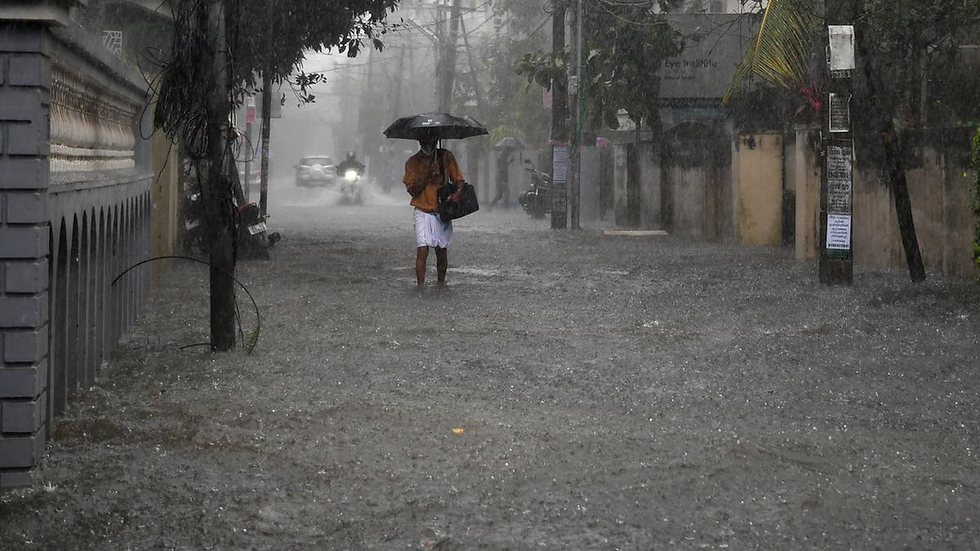
A waterlogged street in Kochi amidst the recent torrential downpours that swiftly submerged different areas of the city within a matter of hours | Photo Credit: H. Vibhu
In 2022, Kerala witnessed heavy rainfall coinciding with active phases of the MJO in the equatorial Indian Ocean. Moreover, research suggested that these active phases from September to November has the potential to cause a delay in the withdrawal of the Indian Summer Monsoon, impacting agriculture and raising the risk of flooding in certain regions.
The MJO can cause an anomalous change in rainfall activity, which could have disastrous repercussions.
Tropical Cyclone:
MJO has the ability to affect the development and intensity of tropical cyclones in the Indian Ocean. During the active period of the MJO, increased atmospheric instability and moisture can create favourable conditions for the formation and intensification of these cyclones.
However, the exact relationship between MJO and tropical cyclones is much more complex as other factors like sea surface temperature, wind shear, etc. also play a dominant role.

Mumbai/Ahmedabad: Cyclonic storm ‘Nisarga’ made landfall at Alibaug in Maharashtra’s Raigad district on Wednesday afternoon | Photo Credit: Times of India, 2020.
The severe cyclonic storm Nisarga that occurred in the North Indian Ocean (year 2020) was observed to intensify rapidly during the active phases of MJO.
With a staggering toll, this catastrophic cyclone wreaked havoc on the districts of Raigad, Ratnagiri, and Sindhudurg in June, leaving in its wake an estimated financial toll of Rs 6,048 crore, as assessed by the Maharashtra government.
So what’s next?
In light of the constantly shifting and uncertain weather patterns we witness in present times, it becomes evident that climate change is exerting some influence.
According to recent studies, convective cloud bands associated with the MJO have experienced shorter lifetimes (lower rainfall) over the Indian Ocean while experiencing longer stays (increased rainfall) over the Maritime Continent.
The evolving research in this field promises valuable insights into the complex interplay between climate change, the MJO, and the ever-changing face of our weather.
References:
Krishnamohan, K. S., Mohanakumar, K., & Joseph, P. V. (2012). The influence of Madden–Julian Oscillation in the genesis of North Indian Ocean tropical cyclones. Theoretical and Applied Climatology, 109(1), 271–282. https://doi.org/10.1007/s00704-011-0582-x
Madden, R. A., & Julian, P. R. (1971). Detection of a 40–50 Day Oscillation in the Zonal Wind in the Tropical Pacific. Journal of Atmospheric Sciences, 28(5), 702–708. https://doi.org/10.1175/1520-0469(1971)028<0702:DOADOI>2.0.CO;2
Putatunda, I., Rakesh, V., & Mohapatra, G. N. (2022). Investigation of the role of Ocean-Atmosphere Interactions on Unusual Characteristics of Severe Indian Ocean Cyclone Nisarga. AGU Fall Meeting Abstracts, 2022, A21E-09.
Roxy, M. K., Dasgupta, P., McPhaden, M. J., Suematsu, T., Zhang, C., & Kim, D. (2019). Twofold expansion of the Indo-Pacific warm pool warps the MJO life cycle. Nature, 575(7784), 647–651. https://doi.org/10.1038/s41586-019-1764-4



Comments