What is Climate Change and Why Should You Care?
The climate has always changed. That's not the story. The story is the speed.
To understand why, it helps to zoom out — far out. Over hundreds of thousands of years, the Earth has cycled through ice ages and warm periods, driven by slow shifts in its orbit, volcanic eruptions, and changes in solar activity. We know this from ice cores drilled in Antarctica, from ancient coral reefs, from the sediment at the bottom of the ocean. The climate has been both colder and warmer than it is today. But those shifts played out over tens of thousands of years, slowly enough for life to adapt, migrate, evolve. What is happening now is different. The warming we have seen in the last 150 years is occurring at a pace that has no parallel in the geological record of human civilization. The Earth has been here before. But never this fast.
And this time, the driver isn't orbital mechanics or a supervolcano.
It's us.
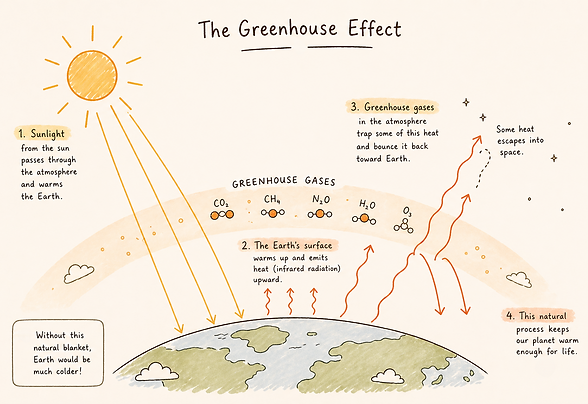
The greenhouse gases we have been pumping into the atmosphere since the Industrial Revolution are trapping heat that would otherwise escape. The planet is warming. And a warmer planet doesn't just mean hotter summers. It means more.
More intense storms, as warmer oceans fuel stronger systems. More erratic rainfall patterns, as the processes that shape monsoons are increasingly disrupted. In some regions, unusual cold extremes may be linked to changes in atmospheric circulation as the Arctic warms — though this remains an active area of research. More floods, more droughts, sometimes in the same place within the same year.
The climate system is not a single dial you turn up. It is an interconnected web — oceans, atmosphere, ice, land, life — where a change in one place ripples through everything else. The Arctic is warming four times faster than the rest of the planet. The loss of land ice in Greenland and other ice sheets is contributing to rising sea levels for coastal cities thousands of kilometres away. The glaciers retreating in the Himalayas are altering seasonal water availability for millions, with broader implications for over a billion people downstream. And the Atlantic Ocean circulation that regulates temperatures across Europe and South Asia is showing signs of serious stress, recent studies suggest it is on course to slow by more than 50% by the end of this century, with consequences that could reshape weather patterns for generations.
And we are not the only ones paying the price.
Credit: Rohan Chakravarty
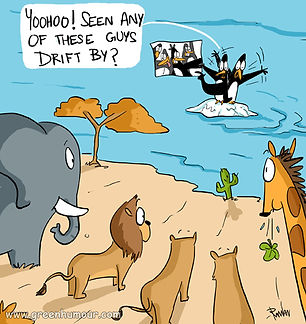
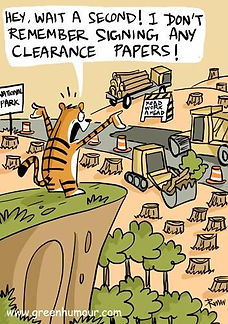
Every ecosystem on the planet is absorbing the consequences of choices it had no part in making. Coral reefs — among the most biodiverse places on Earth — are bleaching and dying as ocean temperatures rise. Polar bears are losing the sea ice they hunt from. Migratory birds are arriving at destinations where the insects they depend on have already come and gone, the timing thrown off by a warming spring. In the oceans, acidification is making it harder for shell-forming organisms to build and maintain the structures that support the marine food chain. On land, deforestation driven by the demand for agriculture, development, and resources is stripping away the forests that regulate rainfall, store carbon, and shelter millions of species. We are not just changing the climate. We are dismantling the ecosystems that buffer us from its worst effects, while the species that share this planet with us vanish quietly, without headlines.
These are not distant problems. They are already unfolding.
And they show up in ordinary life in ways we don't always connect back to the bigger picture. The vegetable prices that spiked after an unseasonal frost. The water cuts that stretched longer this summer. The cyclone that intensified faster than the forecast predicted. The winter that arrived late and left early. These are not just isolated incidents. Many are signals increasingly influenced by a climate system under stress.
Now think about who feels those signals first.
A farmer dependent on the monsoon has no buffer when it fails. A fisherman on a low-lying coast has nowhere to go when the sea rises. A construction worker has no escape from the heat. And yes, if you have an air conditioner, a car, a steady income, you are buffered. For now. But here is the thing about a system under stress: the buffers don't hold forever. The electricity bill climbs. The water supply tightens. The food prices shift. The extreme event that used to happen once a decade starts happening every few years. Luxury buys you time. It does not buy you immunity. At some point, and that point is arriving sooner than most people think, no one is entirely insulated from a climate that is fundamentally changing the conditions of life on this planet.
Climate change does not create injustice. It amplifies the injustice that already exists. But eventually, it comes for everyone.
This is why it matters — not just to scientists, not just to activists, not just to people in vulnerable regions. Because the systems that are destabilizing — water, food, weather, oceans, the living world — are the systems that all of us depend on, regardless of where we live or what we earn.
Understanding what is changing, and why, is not optional anymore.
It's the context for everything else.